
Labour Court v Industrial Court
- Wei Jian Yip
- Oct 22, 2020
- 5 min read

Updated: Jul 31, 2021
When it comes to employment and industrial relation disputes in Malaysia, there are generally 2 courts which deal with them in the first instance. They are the Labour Court and the Industrial Court. At first glance it may be difficult to distinguish them. However, they both serve very different and distinct purposes when it comes to their functions.
In this article, I will look to distinguish them and provide a short description on their functions.
Labour Court
The Labour Court is a ‘Court’ which functions under the purview of the Employment Act 1955 (“EA 1955”). While the court in itself does not actually exist in name, the Director General of Labour (“DGL”) is provided under the EA 1955 to hear matters relating to wages when a complaint is referred, thus the establishment of the ‘Labour Court’. Under Section 69 of EA 1955, the DGL has the power to enquire and hear matters in respect of wage disputes of the employee only.
It is important to note that the Labour Court can only hear matters brought by employees who fall as stated under the First Schedule of the EA 1955 including manual laborers and employee whose salary is no more than RM2,000. That being said, the EA 1955 has also conferred to the DGL the power to hear matters with regards to employees whose salaries are not more than RM5000.00 per month[1]. Most common issues being heard at the Labour Court includes disputes for non-payment of salary and/or non-payment of termination benefits.
The process at the Labour Court follows a claim in a civil court wherein parties are allowed to file in pleadings in to court and to cross examine witnesses before an officer appointed by the DGL. Following which the officer will make a decision on the matter to either dismiss the complaint as the employee’s claim is not proven or compel the company to pay the unpaid wages.
In a nutshell, the premise of this ‘Labour Court’ is restricted to the determination of the monetary aspects of a contract of service. Where a decision has been made by a DGL for wages or monetary payments to be made, that decision can be enforced in a civil court either in the Sessions Court or Magistrates Court depending on the monetary sum involved in the claim.
Industrial Court
On the other hand, the Industrial Court functions under the purview of the Industrial Relations Act 1967 (“IRA 1967”). The Industrial Court does not sit in the traditional capacity of the civil courts but rather as a special entity set up to hear matters pertaining to workman, employers and trade unions permitting specific performances such as reinstatement to be awarded.
A material difference between the Labour Court and the Industrial Court is that unlike the Labour Court, any employee who falls under the definition of ‘workman’ in Section 2 of the IRA 1967 could have their matter heard before the Industrial Court.
One of the common matters heard at the Industrial Court is pursuant to Section 20 of the IRA 1967. Under section 20, an employee may make representations to the Industrial Relations Department should he believe that he has been unfairly dismised and is seeking to be reinstated to his former position. Dismissals can come in various forms including retrenchment, dismissal due to poor performance or misconduct. In addition, a claim under section 20 of the IRA 1967 can also be made on grounds for constructive dismissal.
When a representation is made, a conciliation meeting is held between the complainant and the company to attempt to resolve the matter. Should the matter not be resolved during the conciliation meeting, the DGIR may refer the matter to the Minister of Human Resource (“MOHR”). The MOHR may then refer the matter to the Industrial Court in order for the matter to be adjudicated.
(Editor's note: Following the recent amendments to section 20 of the IRA 1967, the MOHR no longer refers the matter to the Industrial Court but instead the DGIR shall refer the representation to the Industrial Court where the DGIR is satisfied that there is no likelihood of the representation being resolved at the conciliation meeting)
At the Industrial Court, parties will file pleadings and subsequently proceed to trial where witnesses from both sides will file in their witness statements and be cross examined by the opposing party. Following the conclusion of trial, the learned Court will then consider all the evidence before the Court to determine the key question being: Was the employee(s) unfairly dismissed?
Should the employee be found to be unfairly dismissed by the company, the Court will order the following remedies to be awarded to the employee:
a) Backwages
Backwages are awarded at the discretion of the Industrial Court for up to 24 months (or 12 months in the case of probationers). In awarding backwages, the Court may consider several factors including the employee’s current employment position and if any effort was made by the employee to seek employment.
b) Reinstatement
In the case of reinstatement, the Industrial Court is unique as it is the only Court that provides for such a remedy for specific performance against a company to reinstate the employee as they were unfairly dismissed.
However, it should be noted that the Industrial Court has the discretion to award compensation in lieu of reinstatement in the interest of workplace harmony. In such cases the Court will calculate the compensation by awarding 1-month salary for every year of completed service with the company.
The MOHR may also refer other matters to be adjudicated before the Industrial Court including trade disputes[2] the interference with the rights of a trade union and its members[3].
However, there are also matters where the Industrial Court can hear directly without it being first referred to from the MOHR. One example is where an Award made by the Industrial Court and/or a Collective Award between a trade union and an employer is not complied with, the party who was defaulted of its payment and/or compliance with the terms may lodge a complaint to the Court. Section 56 of the IRA 1967 permits the Court to then make an order directing the party to comply with the terms in the Award or Collective Agreement.
Other matters which can be directly applied to the Industrial Court to be adjudicated is for the interpretation of Awards/Collective Awards[4] and to apply for the variation of an Award/Collective Awards[5].
Similar to the decisions at the Labour Court, decisions from the Industrial Court can be enforced at the civil courts when all appeal avenues for non-compliance of Awards/Collective Awards have been exhausted at the Industrial Court.
Thus, the uniqueness of the Industrial Court in its function to hear the matters as shown above provides an avenue of recourse for employees and/or trade unions without undergoing the tedious and expensive process in the civil court.
Conclusion
Therefore, a claim made at the Labour Court or the Industrial Court would be based upon to their inherent jurisdictions to hear the matters. An employee (or former employee) will have to be cautious in filing their claims in taking into account what remedy are they seeking with it being either to claim unpaid salary or reinstatement in the cases where an employee felt that they have been unfairly dismissed.
While it is understandable that the decisions from this Court may not appease the losing party, the losing party may consider making an appeal by way of a judicial review to the High Court pursuant to Order 53 of the Rules of Court 2012. That is a tale for another day!
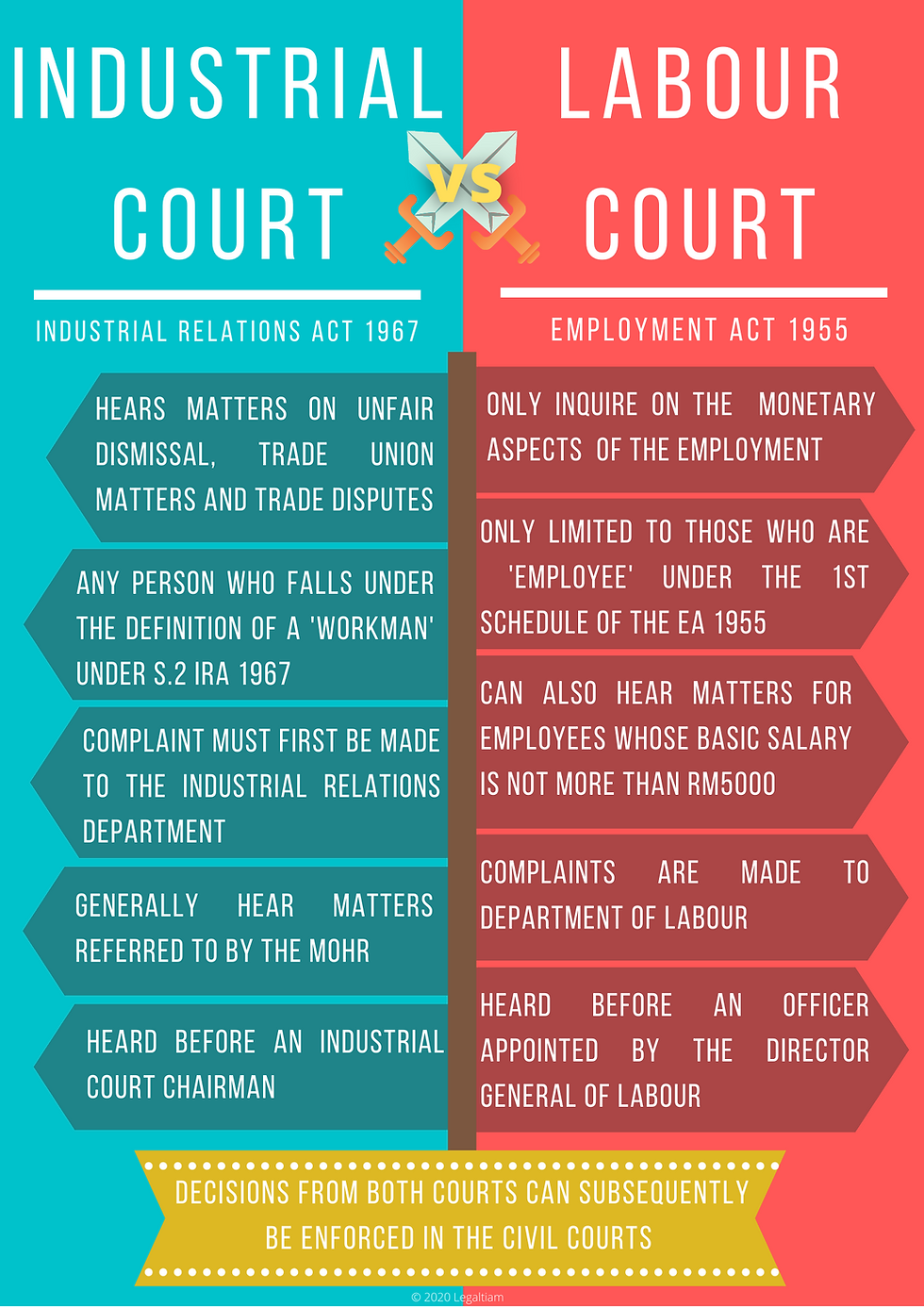
Infographic
Here are some key takeaways from the article above.
Written by Yip Wei Jian


Comments